
Awesome Code Points
This is a curated list of characters in Unicode, that have interesting (and maybe not widely known) features or are awesome in some other way.
Table of Contents
- Standalone code points
- Code points that affect others
- Record holders and extremes
- For funsies
- Other Lists of Code Points
- Contributing
- License
Standalone Code Points
- The code points of the Unicode blocks Box
Drawing (U+2500 to U+257F) and Block
Elements (U+2580 to U+259F) cover
most of your monospace command-line visualization needs.
╭───────╮ │Unicode│ │rules! │ ╰┬─────┬╯- U+2E2E REVERSED QUESTION MARK - the “irony mark” to express irony/sarcasm. A useful character⸮
- U+D800 to U+DFFF - surrogate code points. They are only reserved to ease UTF-16 encoding.
- U+FEFF ZERO WIDTH NO-BREAK SPACE - it’s name suggests, that it can be used like U+2060 WORD JOINER. And in fact the latter was introduced to inherit its semantics. This is because U+FEFF had become a special beacon called the byte order mark, that was placed on the beginning of some UTF-8 files. In complying software (including many text editors) this character is stripped from the start of a file and handled as metadata. In non-complying software (like the PHP interpreter) this leads to all sorts of fun behaviour.
- U+FFFD REPLACEMENT CHARACTER - when a character cannot be displayed (e.g., decoding an erroneous UTF-8 sequency), this code point steps into the breach.
- U+1D455 is missing. It would be an italic small “h”. It was not encoded, because it would be identical to the Planck constant ℎ (U+210E).
- U+FF03 FULLWIDTH NUMBER SIGN - it is the
"Japanese Hashtag"
#. Sites like Twitter accept it as equivalent to the regular#(U+0023).
Code Points that Affect Others
-
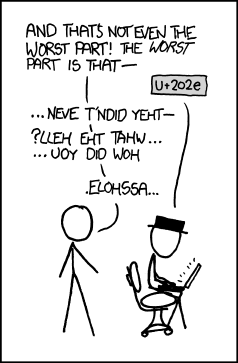
U+202D and U+202E - change the text direction. Relevant XKCD:
* U+FE0E VARIATION SELECTOR-15 - force
black-&-white emoji. If this code point follows an emoji, an explicit
monochrome rendering of the emoji is requested (if the client supports it).
* U+FE0F VARIATION SELECTOR-16 - force
colorful emoji. If this code point follows an emoji, an explicit colorful
rendering of the emoji is requested (if the client supports it).
* Diacritics and combining marks: There is a host of
characters, that add
to the characters before. Those are called Combining Marks. Unicode
provides a handy FAQ on the
details, but in a nutshell: If you add one after a character, it is placed
on top of that previous one. So, a + ̊ = å. This may lead to all kinds of funny problems, because for some combinations there are pre-composed characters. Our littleåhere can also be encoded as U+00E5. You might note, that while this has a length of one character, the combination ofaand combining ring has a length of two characters.Of course, one can also do fun things with those characters like this answer on StackOverflow. * The Regional Indicator Symbols U+1F1E6 to U+1F1FF resemble the 26 latin characters. They are used to create flag emoji. Since the Unicode consortium didn’t feel like getting on board with international politics, the solution to flags is to combine these 26 characters to the respective ISO code for a country. Examples:
Country ISO Code Code Points Emoji (if supported) USA US U+1F1FA + U+1F1F8 🇺🇸 Germany DE U+1F1E9 + U+1F1EA 🇩🇪 China CN U+1F1E8 + U+1F1F3 🇨🇳 * Skin color of emoji: There are five code points, that control the skin color